What If An OnlyFans Creator Was Sent to Ancient Rome?
A FriedReads "What If" Special — No Wi-Fi, No Problem.
OnlyFans Creator Sent to Ancient Rome (And Other Hysterical Time Travel Scenarios) 📱🏛️🔥
A FriedReads "What If" Special — No Wi-Fi, No Problem (Actually, Lots of Problems)
June 2026
A NOTE BEFORE WE BEGIN
Let me be clear about something.
I don't know how to run a society. I've never been a politician. I've never been an economist. I've never even managed a small team without someone crying. I critique things from my room — my messy, slightly smelly room — and that's the extent of my expertise.
I'm not here to judge anyone's lifestyle. Not the Romans. Not the Greeks. Not the Victorians. And definitely not OnlyFans creators.
This isn't a critique. This is a comedy.
A thought experiment. A "what if" that exists purely to make you laugh, maybe think a little, and then laugh again.
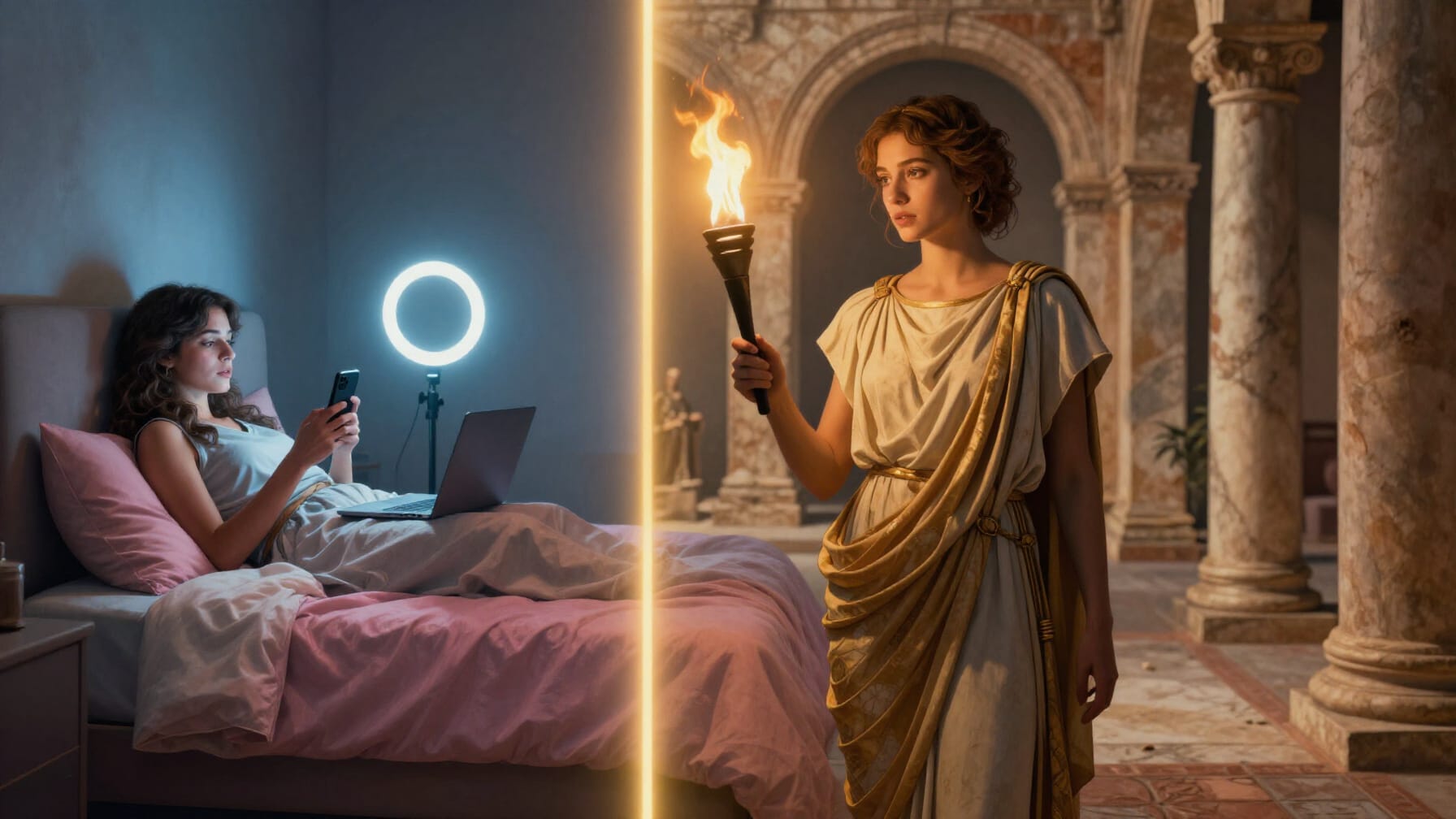
So here's the premise: an OnlyFans creator in 2026. Successful. Good at her job. Understands lighting, angles, parasocial relationships, subscription tiers, and the delicate art of making people feel seen without being known.
Now drop her into a time period where none of that exists.
No internet. No cameras. No payment processors. No "content." Just her. Her body. Her wits. And a world that doesn't know what to do with any of it.
This is not a history lesson. This is not a polemic. This is me, at a keyboard, trying to make you laugh by imagining a Roman senator trying to figure out what "subscribe to my OnlyFans" means.
Let's go.
THE SETUP — Who Is She? 👩💻
Let's call her Maya.
Maya is 28. She started her OnlyFans during the pandemic because she lost her waitressing job and had rent due. She didn't expect to succeed. She wasn't a "model." She wasn't an "influencer." She was just... good at it.
She understood lighting. She understood angles. She understood what people wanted: not just bodies, but connection. The illusion of intimacy. The feeling that someone, somewhere, was paying attention just to them.
Three years later, she's in the top 5%. She makes six figures. She has a manager, a brand, and a carefully curated persona. She's not rich, but she's comfortable. She's not famous, but she's known.
And she's thinking about quitting.
Not because she's ashamed. Because she's tired. Because the more she performs connection, the less she experiences it. Her "fans" aren't real. Her "relationships" are transactions. Her "intimacy" is a product.
She's wondering what comes next.
And then she wakes up in ancient Rome.
PART ONE: THE ARRIVAL — "Where's My Phone?" 📱❌
Maya wakes up on a stone floor. It's cold. It's hard. It smells like feet and fermented fish.
She pats her pockets. No phone. No keys. No wallet. Just her clothes — a hoodie, leggings, and sneakers.
She looks around. Stone walls. Torches. A distant sound of... screaming? Cheering? She can't tell.
A man in a toga walks past. He looks at her. She looks at him.
"Where am I?" she asks.
He says something in Latin. She doesn't understand.
She tries English. French. Spanish. The little Japanese she learned from anime. Nothing works.
She mimes "phone." She holds her hand to her ear. She makes a "ring ring" sound.
The man looks confused. Then concerned. Then he crosses himself (or whatever Romans did) and walks away faster.
Maya is alone. In ancient Rome. With no Wi-Fi, no cell service, and no idea how to charge anything.
The First Problem:
Her skills are useless. She can't farm. She can't fight. She can't weave. She can't heal. She can't do anything that pre-modern societies value.
But she can make people feel seen. She can perform intimacy. She can create a persona that people want to be near.
In 2026, that's a career. In 50 BC, that's... something else.
PART TWO: THE ADAPTATION — "I Guess I'm a Courtesan Now?" 🏛️👑
Maya finds work. Not at a desk. Not on a platform. At a... house. A special house. Run by a woman named Valeria who looks at Maya's face, her posture, her confidence, and sees opportunity.
"You're not Roman," Valeria says. Her Latin is slow, simplified. Maya can almost understand.
"I'm not anything," Maya says.
"You're beautiful," Valeria says. "And you have something. Something I can't name. The way you look at people. Like you see them. Like you know them."
Maya almost laughs. That's not a gift. That's training. That's years of performing intimacy for strangers who think they know her.
But in ancient Rome? That's a skill. A rare one.
The Job:
Valeria trains Maya in the art of the hetaira — a high-class courtesan. Not a prostitute. Not a slave. Something else. A woman who is educated, cultured, and companionable. A woman who can talk about philosophy, politics, and poetry. A woman whose body is her business, but whose mind is her brand.
Maya is good at this. Scarily good.
She knows how to listen. She knows how to ask questions. She knows how to make a man feel like the most important person in the world — for the length of a conversation.
She sets up "tiers" without calling them tiers. She offers "exclusive content" without calling it content. She builds a following without an algorithm.
Within a month, she's the most sought-after courtesan in her district.
The Problem:
She's lonely.
The men who visit her don't know her. They know the persona. The performance. The woman who makes them feel seen.
She's back where she started. Just with better lighting (torches) and worse hygiene.
PART THREE: THE FAN — "You Don't Know Me" 😕📜
A Roman soldier named Marcus becomes her regular. He's young. Handsome. Earnest. He writes her letters. Long, heartfelt letters about his dreams, his fears, his hopes for the future.
She reads them. She's touched. No one has ever written her a letter before.
But she doesn't respond. She can't. She's not allowed to have personal connections. That's not the job.
One night, after a session, Marcus stays longer than usual.
"I think I love you," he says.
Maya doesn't know what to say. She's heard this before — in DMs, in comments, in desperate messages from strangers who think the persona is real.
"You don't know me," she says.
"I know you," he insists. "I know your heart. I know your soul. I know the real you."
Maya almost laughs. Almost cries. The real her? The real her is a girl from Ohio who started an OnlyFans because she was broke and scared and didn't know what else to do. The real her is tired. The real her is lonely.
The real her is standing in ancient Rome, wearing a stola, wondering if any of this matters.
"You know the version of me I show you," she says. "That's not the same thing."
Marcus doesn't understand. He walks away. He doesn't come back.
PART FOUR: THE INVENTION — "I Accidentally Created the Gig Economy" 💸🏛️
Word spreads. Maya is not just a courtesan. She's a phenomenon. Men come from across the city to see her. Women, too, though they're quieter about it.
She starts teaching other women. Not the "work" — the "brand." The persona. The performance.
"Make them feel seen," she says. "Ask questions. Listen. Remember small details. Make them believe that you, and only you, understand them."
The other women are confused. "That's just... being nice," one says.
"No," Maya says. "It's a strategy. It's a skill. It's how you make them come back."
She doesn't call it "customer retention." She doesn't call it "brand loyalty." She calls it "being good at your job."
A Roman entrepreneur hears about her methods. He wants to invest. He wants to scale. He wants to build a "house of companions" with multiple locations, tiered services, and a referral program.
Maya laughs. Then she stops laughing. She's accidentally invented the gig economy in ancient Rome.
She's not sure if she's proud or horrified.
PART FIVE: THE CRISIS — "Is This All There Is?" 😔
One night, Maya sits alone. The house is quiet. The torches flicker.
She thinks about her life in 2026. The late nights editing content. The endless DMs. The parasocial relationships that felt real but weren't. The money, good, but not enough to fill the emptiness.
She thinks about her life in Rome. The men who visit. The women she trains. The "success" that feels exactly the same as before.
She's still performing. Still pretending. Still selling a version of herself that doesn't exist.
The only difference is the lighting.
The Realization:
The problem wasn't the platform. It wasn't the technology. It wasn't the time period.
The problem was her.
She'd been running away from something her whole life. From vulnerability. From real connection. From the terrifying possibility of being truly known.
OnlyFans was just a container. Rome was just another container.
The emptiness was inside her the whole time.
PART SIX: THE CHOICE — "I'm Done Performing" 🕊️
Maya stops.
She stops performing. She stops branding. She stops building a persona.
She tells Valeria she's quitting. Valeria is confused. "You're the best I have," she says.
"I'm tired of being the best," Maya says. "I want to be real."
She finds Marcus. She finds the soldier who wrote her letters, the one who said he loved her, the one she pushed away.
She tells him everything. Not the performance. The truth. About Ohio. About OnlyFans. About the loneliness. About the fear.
He doesn't understand all of it. But he understands enough.
"I don't care where you came from," he says. "I care where you are."
She stays in Rome. Not as a courtesan. As a person. A real person. With a real life. Real connections. Real intimacy — not performed, not monetized, just lived.
She never goes back to 2026.
She doesn't want to.
THE SATIRICAL PUNCHLINE (Because There Has to Be One) 🎭
The OnlyFans creator went back in time and became a courtesan. She was successful. Desired. Safe.
And she was just as lonely as she was in 2026.
Because the problem wasn't the platform. It wasn't the technology. It was the human condition.
The desire to be seen. The fear of being known. The distance between performance and reality.
That's not modern. That's timeless.
OnlyFans isn't new. It's just a new container for something very old.
And if you sent a creator back in time, she wouldn't invent OnlyFans. She'd become a hetaira. Or a geisha. Or a muse.
Because the desire to be desired? That never changes.
The only thing that changes is the lighting.
THE FINAL LINE:
Maya went back in time and found herself. The irony is not lost on her. Or on the Roman soldier who loved her. Or on the readers who realized the joke was on them all along.
📱🏛️💔
Allen FriedReads.com | Not a historian. Not a critic. Just a guy with a keyboard. June 2026