The Public Meltdown Reimbursement Program: Your Breakdown, Our Business
A Modest Proposal to Monetize Mental Collapse in Shared Spaces
The Public Meltdown Reimbursement Program: Your Breakdown, Our Business 😭💵
Or: How I Learned to Stop Worrying and Profit From My Airport Screaming
Attention!
Let's set the scene.
You're at the DMV. You've been here for two hours. Your number is 347. The screen says "NOW SERVING: 182." The woman at the counter is explaining, very slowly and with the patience of a saint who has long since abandoned her faith, that she cannot accept "vibes" as a form of identification.
Behind you, a man in his 60s is quietly weeping into his expired license. His hands are shaking. He's been here since 8 AM. It's now 11:47. He's not angry. He's just... done. The weeping is soft, almost musical—a low, mournful hum of a man who has surrendered to the machine.
In the corner, a teenager is having a full, unfiltered conversation with the wall. The wall isn't responding. This does not deter the teenager.
And then—THEN—the person at the front counter, the one who was just called after waiting FOUR HOURS, is told their form is "slightly incorrect" and they need to start over.
The sound that comes out of them is not human. It's a guttural, primal wail that echoes through the fluorescent hellscape like a dying whale communicating with God.
Everyone pretends not to notice. We scroll our phones. We study the floor. We become experts in the ceiling tiles.
This is modern life.
Public spaces are pressure cookers. And sometimes—often—the lid blows clean off.
I: THE PROBLEM — Meltdowns Are Everywhere and Nobody Knows What to Do 😤🌍
Let's be honest with ourselves for a moment.
You've seen it. You've probably BEEN it. That moment when the thing that was already too much becomes one thing too many, and something inside you just... snaps.
Maybe it's at the airport when your third flight gets canceled and the gate agent says "we can rebook you for Thursday" and it's Monday and you have a meeting in three hours and also your cat is alone and probably dying and also you're pretty sure the gate agent is enjoying this.
Maybe it's at the grocery store when the self-checkout machine says "unexpected item in bagging area" and you look at the unexpected item—a single banana, innocent, unassuming—and you understand, in that moment, that the machine is lying. There is no unexpected item. The machine is gaslighting you. And you snap.
Maybe it's at work. Maybe it's on the bus. Maybe it's in the parking lot of a Target at 10 PM when you realize you left your wallet at home and you have a cart full of things you don't need but desperately wanted.
The point is: public meltdowns are everywhere. They're the background radiation of modern existence. And we have absolutely no idea what to do about them.
The Current Protocol:
When someone loses it in public, we have three options:
- Ignore them. Pretend it's not happening. Scroll your phone with intense focus. Become suddenly fascinated by a crack in the wall. This is the most common response. It's also the most cowardly. We've all done it. 📱🙈
- Remove them. Security escort. Lifetime ban. Viral TikTok fame. This is the "official" response—the one that makes everyone feel like something was done, even though nothing was solved. The meltdowner gets escorted out. The problem gets moved, not fixed. 🚫📹
- Join them. Escalate. Engage. Add your scream to the chorus. This is rare, but beautiful when it happens. Two strangers, united by chaos, screaming at the sky together. It's almost romantic. 🔥🤝
None of these work.
The meltdowner gets nothing—no resolution, no compensation, no catharsis. The bystanders get secondhand trauma and a story to tell at dinner parties. The workers get paid minimum wage to absorb abuse that would break most people in hours.
The Statistics (Completely Made Up, But Feel True):
- 1 in 3 Americans have witnessed a public meltdown in the past month. 🇺🇸😬
- 1 in 5 have BEEN the meltdowner (they just won't admit it). 🤫
- Airport gate agents report an average of 4.7 "emotional incidents" per shift. ✈️📊
- The DMV has a dedicated "crying corner" in 12 states. (This is not true. It should be. It would help.) 🏛️😭
- 94% of people say they'd rather watch a meltdown than help. The other 6% are lying. 📹👀
The Real Question:
Who actually pays for public rage?
Right now, it's the workers who absorb it. The bystanders who witness it. The meltdowner who suffers it alone, unpaid, unacknowledged, just another casualty of a system designed to break people slowly.
But what if we flipped it?
What if the meltdowner got the check?
II: THE PROPOSAL — The Public Meltdown Reimbursement Act 📜💵
Ladies and gentlemen, I give you the most sensible piece of legislation you've never considered:
"An Act to Provide Financial Compensation for Emotional Outbursts Occurring in Shared Public Spaces, Thereby Redirecting Funds From De-escalation Training to Direct Payouts, Hereinafter Referred to as 'The Screaming Economy Act.'"
Catchy. They should put it on a bumper sticker.
The Core Mechanism:
Any person experiencing a verified public meltdown may apply for compensation. Payouts are tiered based on intensity, duration, and collateral damage. Think of it as workers' comp for the soul.
The Official Tier System:
| Tier | Description | Example | Payout |
|---|---|---|---|
| Tier 1: The Gentle Fizzle | Quiet crying, mild muttering, one (1) audible sigh of existential despair. No property damage. Minimal witness trauma. | Crying at an airport gate after flight cancellation. The kind of crying where you're trying to hide it but failing. The sniffles of a broken spirit. | $20 🥲💵 |
| Tier 2: The Heated Discussion | Raised voice, finger-pointing, three (3) repetitions of "I'm never flying this airline again." May include one (1) "do you know who I AM?" | Argument with customer service about a billing error that is clearly the company's fault but they won't admit it. The classic "let me speak to your manager" energy, but without the Karen hat. | $50 😤💰 |
| Tier 3: The Full Performance | Screaming, crying, throwing objects (non-weaponized—we have standards), use of profanity exceeding 10 words per minute. Must be witnessed by at least 5 strangers. | The "why won't you accept my coupon" grocery store meltdown. The moment when a person realizes their $2 savings isn't worth it but also it's the PRINCIPLE. | $150 😭💸 |
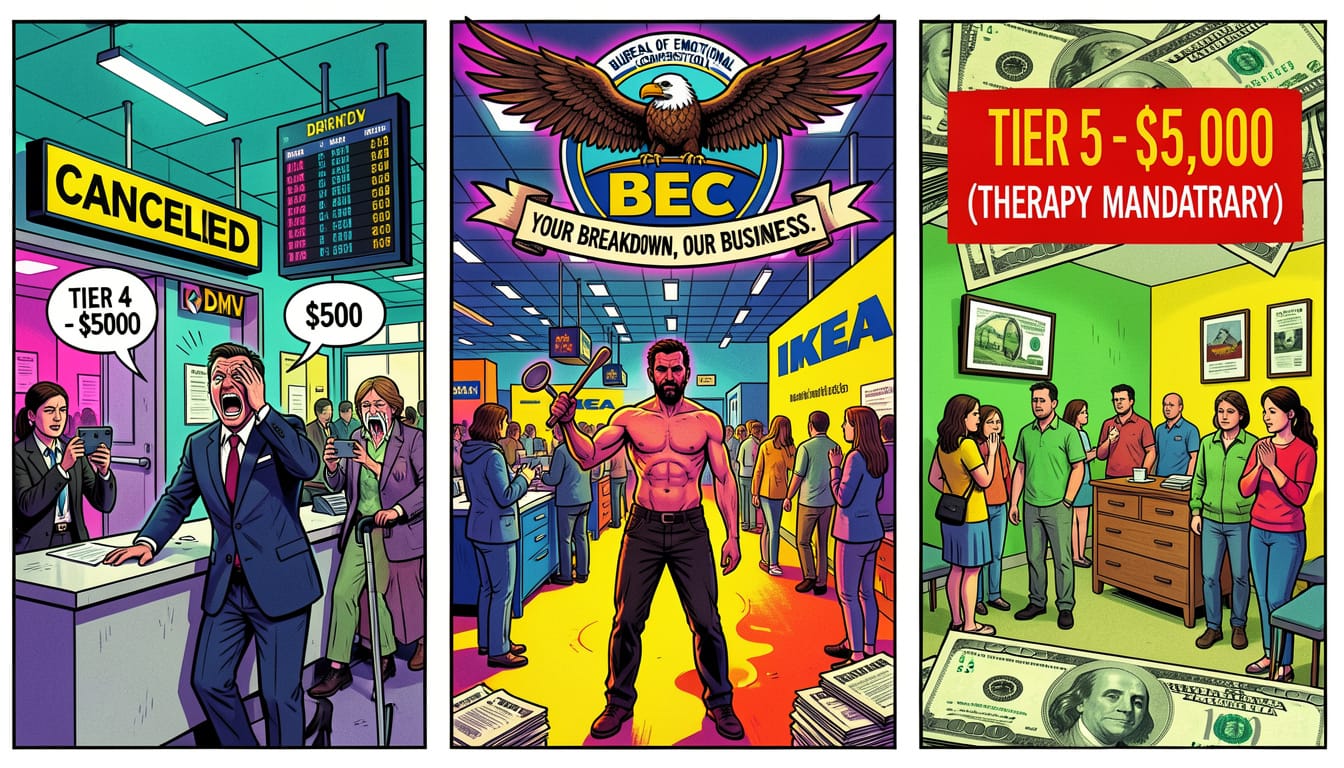
| Tier 4: The Legacy Event | Physical altercation with inanimate objects, removal by security, viral video potential. Must include at least one (1) line that becomes a meme. Bonus points if the line is quotable out of context. | The "Jared, 19" experience. Airport gate agent confrontation. The moment when a person climbs on a counter and delivers an impromptu speech about "the decline of Western civilization" while fellow passengers record for content. | $500 + lifetime supply of stress balls 🎾🤯 |
| Tier 5: The Mythic Breakdown | Requires police intervention, property damage, and/or nudity. Must be referenced in local news for at least 72 hours. Bonus points if the news anchor struggles not to laugh. | Streaking through IKEA while screaming about Swedish meatballs. Full commitment to the bit. A legend is born. | $5,000 + free therapy (mandatory) 🏃♂️🇸🇪💸 |
Verification Process:
Trained "Meltdown Mediators" (formerly known as "bystanders who didn't ask for this responsibility") submit reports via a government app. Video evidence required for Tiers 3-5. Audio only accepted for Tiers 1-2, but quality must be sufficient to capture the "essence of despair."
Payment Method:
Direct deposit within 3-5 business days. Rush processing available for an additional fee (because even bureaucracy can smell your desperation).
Appeals Process:
If your meltdown is denied, you may file Form M-4 (Application for Emotional Reconsideration). Appeal fees are $20, non-refundable, and must be submitted with a notarized statement from at least one witness affirming that you were, in fact, "really feeling it."
III: WELCOME TO MELTDOWN NATION — Hilarious Scenarios From the Front Lines 🎢😫
Scenario 1: The Airport Gate Heard 'Round the World ✈️📢
Flight delayed six hours. No information. Gate agent hiding in the back, pretending to be busy with something important. A man in a business suit—let's call him "Jared, 46"—has been standing at the counter for 45 minutes, waiting for answers that will never come.
The Meltdown, Stage by Stage:
- Stage 1: Loud sigh. Audible. Dramatic. Tier 1 eligible, but Jared is aiming higher. He knows his potential. 🥲
- Stage 2: "I HAVE A MEETING IN 45 MINUTES!" Voice raised. Finger pointing at watch. Tier 2, building momentum. The crowd is starting to notice. 😤
- Stage 3: Throws boarding pass. It flutters gently to the floor, anticlimactic, but the INTENT was there. Tier 3, now we're cooking. 😭
- Stage 4: Climbs on counter. Delivers impromptu speech about "the decline of Western civilization." References the Huns. Somehow ties it to the airline's baggage policy. Tier 4, crowd recording, one woman is already live-streaming. 📹
- Stage 5: Security arrives. Jared goes willingly, head held high, a martyr for the cause. The crowd applauds. Some are crying. It's beautiful. 👏
The Payout: $500.
The Twist: Jared's meeting was a Zoom call he could have joined from anywhere. He just didn't want to. Now he has $500 and a viral video. His boss saw the video. He's getting a raise. The airline banned him for life. He considers this a win.
The Subtext: Jared can afford to melt down. He has a job, a salary, a safety net. The single mom in seat 34B, the one with the crying toddler and the expired credit card? She sat there, silent, jaw clenched, because she can't risk the consequences. Emotional collapse is a luxury. Jared just proved it.
Scenario 2: The DMV Time Capsule 🏛️😭
A woman—mid-30s, exhausted, here since 8 AM—reaches the counter after four hours. She has taken the day off work. She has arranged childcare. She has done everything right.
The clerk examines her form. Pauses. Looks up.
"This form is slightly incorrect."
The woman blinks. "Slightly?"
"You need to start over."
The Meltdown:
- Stage 1: Silent tears. Just... falling. No sound. Pure, distilled despair. Tier 1, but the QUALITY is exceptional. 😢
- Stage 2: "I took the day off work for this." Voice cracking. Tier 2, relatable to everyone within earshot. 😤
- Stage 3: "I have been here since BEFORE THE SUN CAME UP." Louder now. Gesturing at the windows, which indeed show a sun that has moved considerably since her arrival. Tier 3, escalating. 😭
- Stage 4: Collapses gently onto the floor. Assumes fetal position. Surrounded by numbered tickets and expired dreams. Tier 4, artistic choice, highly effective. 🧘♀️
- Stage 5: A Meltdown Mediator (fellow wait-lister) submits video evidence. The app approves within minutes. Technology works sometimes. 📱
The Payout: $500.
The Aftermath: She uses the money to buy lunch and a therapy session. The clerk gets nothing. The DMV remains unchanged. The line continues.
The Subtext: The DMV is designed to break you. It's a feature, not a bug. The meltdown payout is just reparations for participating in a system that hates you.
Scenario 3: The Grocery Store Aisle Showdown 🛒🥊
Two customers. One rotisserie chicken. The last rotisserie chicken.
It's 6 PM. Everyone is tired. Everyone is hungry. Everyone has made poor decisions that led them here.
The Meltdown (Collective):
- Customer A: "I SAW IT FIRST!" Reaches for chicken. 🍗
- Customer B: "I HAD MY HAND ON IT!" Blocks reach. ✋
- Customer A: "THAT'S NOT HOW HAND ON IT WORKS!" Voice rising.
- Customer B: "IT IS TODAY!" Throws a bag of carrots. Not at anyone, just... in the air. Carrots everywhere. 🥕
- Cashier: Watching from a distance, emotionless, has seen this before. Has seen everything before. Is beyond feeling. 😐
The Resolution: A produce stand collapses. Celery is involved. A child is hit (not hard, but still—celery has no business being involved in violence).
The Payout: $50 each. The celery child gets a gift basket (complimentary).
The Subtext: We fight over $5 chickens because everything else is too expensive. The meltdown is about the chicken. The real cause is the economy. But sure, let's focus on the produce.
Scenario 4: The IKEA Mythic Event 🛋️🇸🇪
A man—let's call him "Karl"—has spent three hours in IKEA. He cannot find the exit. He has passed the same MALM dresser seven times. The meatballs have worn off. His will to live is fading.
He approaches an employee.
"Where is the exit?"
The employee smiles the smile of someone who has answered this question 400 times today. "Just follow the arrows on the floor."
Karl looks down. The arrows lead back into the showroom. They always lead back into the showroom. The arrows are lies.
Something inside him breaks.
The Meltdown:
- Stage 1: Removes shoes. This is never a good sign. 👟❌
- Stage 2: Removes shirt. The children are staring. The parents are covering their eyes but also peeking. 👕👀
- Stage 3: Removes pants. Tier 5 threshold has been crossed. There is no going back. 👖🚫
- Stage 4: Runs through the showroom screaming "WHY DOES THE EXIT REQUIRE A SCREWDRIVER AND A PRAYER?" Naked now, free now, a creature of pure chaos. 🏃♂️😱
- Stage 5: Tackled by security near the kitchen displays. He goes down fighting, still screaming about Allen keys. 🛡️
The Payout: $5,000 + mandatory therapy.
The Aftermath: IKEA bans him for life. He becomes a local legend. The showroom path is never explained. Some say he's still running.
The Subtext: IKEA is designed to disorient you so you buy more. Karl's meltdown was inevitable. He's not crazy—he's the first honest man in the building.
Scenario 5: The Karen Catastrophe 💁♀️🔥
A woman demands to speak to the manager. The manager arrives. She demands to speak to the manager's manager. That manager arrives. She demands to speak to the regional manager. At this point, a crowd has gathered. Someone is live-streaming. The regional manager is on vacation. This is not going well.
The Meltdown:
- Stage 1: "DO YOU KNOW WHO I AM?" Classic opener. Tier 2, but the delivery is flawless. 😤
- Stage 2: "I WANT EVERYONE FIRED." Finger pointing, voice cracking. Tier 3, but losing steam—the crowd is starting to turn. 😬
- Stage 3: "THIS ISN'T OVER." Dramatic exit attempt. Tier 4 potential, but—
- Stage 4: Trips over a display. Falls gracefully (as gracefully as one can fall). Pretends it didn't happen. Keeps walking. Doesn't look back. 👠💥
- Stage 5: The video gets 2 million views. She becomes a meme. She leans in. She's now selling merch. 👑📱
The Payout: $500.
The Subtext: Karens exist because the system rewards them. They get what they want often enough to keep trying. The meltdown payout just formalizes what they already believed: their anger is valuable.
IV: THE ECONOMICS — Who Really Pays? 💸🤔
The Funding Mechanism:
The Meltdown Reimbursement Program is funded by the very institutions that cause the meltdowns. It's called "polluter pays" but for emotions.
- A 0.5% tax on "stress-inducing industries": airlines, DMVs, customer service centers, IKEA, and any business that uses hold music composed specifically to induce despair. ✈️🏛️🛋️
- Fines collected from corporations that cause public meltdowns (e.g., airlines that overbook, companies with impossible return policies, any business that says "your call is very important to us" and then leaves you on hold for an hour). 💼⚖️
- Donations from wealthy individuals who enjoy watching chaos from a safe distance. They call it "philanthropy." We call it "chaos tourism." 🎩🍿
The Economic Impact:
Early projections suggest the program will:
- Increase public meltdowns by 400% (obviously—people will start training for this). 📈😭
- Decrease workplace violence by 15% (rage redirected to payouts rather than people). 📉👊
- Create 50,000 new "Meltdown Mediator" jobs (entry-level, no experience required, must be comfortable with screaming). 👨💼📋
- Generate $2 billion in viral video revenue (content creators will follow meltdowners like paparazzi). 📹💰
- Reduce the national deficit by approximately $0 (but it'll feel like we did something). 🇺🇸🤷
The Unspoken Truth:
The people who melt down most will be the people with the least to lose. The working poor can't afford to lose it—they need their jobs, their housing, their tenuous grip on stability. The wealthy rarely melt down in public—they have private spaces for that. Yachts. Therapists. Scream rooms specifically designed for this purpose.
The program becomes a transfer payment from stress industries to the stressed. It's welfare for the emotionally exhausted. It's reparations for existing in a world designed to break you slowly, methodically, one small indignity at a time.
The Question We're Not Supposed to Ask:
Is it better to pay people for their pain, or to fix the systems causing it?
We know the answer. We're not going to do it. But we know it.
V: THE NUANCE — What We're Actually Talking About 🎭💭
Let's pause the jokes for a moment. Let's look at what's really under this proposal.
Layer 1: Emotional Labor
Customer service workers are paid to absorb abuse. It's in the job description, implicitly if not explicitly. They're human shields for corporations. They stand between the public and the company, taking hits that would level most people.
The meltdown payout doesn't help them. It doesn't give them a raise. It doesn't shorten their shifts. It doesn't provide therapy for the trauma they accumulate. It just redirects the transaction—the abuser gets paid, the absorber gets nothing.
The Question: Who deserves compensation for public rage? The person expressing it, or the person forced to endure it day after day?
Layer 2: The Privilege of Collapse
Emotional stability is a luxury. To keep it together, you need:
- A job that tolerates your presence tomorrow. 💼
- A support system that won't abandon you. 👨👩👧
- Enough money to absorb the consequences of a bad day. 💰
- Enough privilege to be seen as "stressed" rather than "dangerous." ⚖️
- Enough margin in your life that one breakdown won't derail everything. 📅
The person who melts down and gets paid is, by definition, someone who can afford to. They have the slack. They have the safety net. They have the privilege of falling apart in public and walking away with cash.
The person who can't afford to lose it stays silent. Jaw clenched. Eyes forward. Breathing through the rage. They go back to work. They smile at customers. They pretend everything is fine.
The Dark Truth: The program rewards the people who already have the most. The truly desperate can't participate. They're too busy surviving.
Layer 3: The Spectacle Economy
We love watching people lose it. Viral meltdown videos are a genre. We share them. We mock them. We make compilations with laugh tracks. We turn human suffering into content, and content into ad revenue.
The meltdown payout just monetizes what we already consume for free. It turns pain into product, and product into cash. The circle closes. The machine feeds.
Layer 4: The Systemic Gaslight
The program is a classic "solution" that solves nothing. It doesn't fix the overbooked flights, the impossible DMV lines, the confusing IKEA paths, the customer service systems designed to exhaust you into surrender.
It just compensates the casualties. It pays people for their pain and calls it progress.
It's the perfect metaphor for modern governance: address the symptoms, ignore the causes, declare victory, move on.
Layer 5: The Honesty of It All
But maybe—just maybe—there's something honest about this.
Maybe paying people for their meltdowns acknowledges a truth we usually hide: that the system is broken, that it breaks people, and that we owe them something for that.
Maybe it's not a solution. Maybe it's just an acknowledgment. A receipt for damage done. A small, pathetic, bureaucratic way of saying "we see you. we broke you. here's $20."
It's not enough. It'll never be enough. But it's more than they get now.
VI: THE OBJECTIONS — Addressed With Snark 😏🗣️
Objection 1: "This will encourage people to fake meltdowns for money."
Response: Yes. Obviously. That's the point. The "faking" will become performance art. People will train for it. There will be meltdown coaches, meltdown competitions, meltdown TikToks. The economy will adapt. By Tier 5, we won't know what's real anymore. That's also the point. We already don't know what's real. At least now there's a payout.
Objection 2: "This is unfair to workers who have to endure the meltdowns."
Response: Workers can also apply. If a customer service agent snaps after their 50th "I WANT TO SPEAK TO THE MANAGER" of the day, they get paid too. If a gate agent finally loses it and screams back at the screaming passenger, they get paid too. Everyone is eligible. Chaos is democratic.
Objection 3: "This will make public spaces even more chaotic."
Response: Have you BEEN to a public space lately? The chaos is already here. We're just naming it. We're just putting a price tag on it. The chaos was always the point. Now it's also the product.
Objection 4: "This is degrading to people with genuine mental health crises."
Response: Valid. The program includes a "genuine crisis" exemption—if your meltdown is diagnosed by a professional, you get double. Mental health awareness is important. Also, we have a sponsor. Also, maybe if we paid people for their pain, they could afford the help they need. Just a thought.
Objection 5: "This is the dumbest idea I've ever heard."
Response: Thank you. I worked hard on it. Now watch the video of the naked man running through IKEA. Tell me that's not worth something.
VII: THE OFFICIAL FORMS — Because Every Program Needs Bureaucracy 📋😭
Form M-1: Meltdown Incident Report
- Date, time, location of incident. (Be specific. "The parking lot of despair" is not acceptable.)
- Tier level (self-reported, subject to mediator verification, appeals available for an additional fee).
- Description of trigger (e.g., "flight delayed," "DMV line," "existential dread," "the machine said 'unexpected item' and there was no unexpected item, it was a lie, everything is lies").
- Witness statements (minimum 2 required for Tiers 3+. Witnesses may apply for "emotional distress compensation" separately).
- Video evidence upload (optional for Tiers 1-2, mandatory for Tiers 3-5. Portrait orientation automatically downgrades one tier).
- Meme potential assessment (for Tier 4+ bonuses, must be completed by certified internet culture expert).
Form M-2: Emotional Damage Assessment
- Intensity scale (1-10, with 10 being "the exorcist" and 1 being "I sighed once and someone noticed").
- Duration (in minutes, rounded up because suffering doesn't round down).
- Collateral damage estimate (property damage, dignity damage, bystander trauma, number of children who will need therapy).
- Scream quality (pitch, volume, emotional authenticity, did it make the recording app distort).
- Tears assessment (volume, salt content, aesthetic value on camera).
Form M-3: Payout Election
- Direct deposit (3-5 business days, because even meltdowns must wait for bureaucracy).
- Screaming credit (redeemable at participating stress venues—airports, DMVs, IKEA—for priority service or a free meatball).
- Charitable donation option (funds go to "Future Meltdowners Scholarship" for aspiring breakdown artists).
- Re-investment option (use payout to fund next meltdown, create content, build brand, go viral, repeat).
Form M-4: Appeal of Denied Claim
- Submit within 30 days (grief has a statute of limitations).
- Include additional evidence (louder recording, more witnesses, therapy note from licensed professional, signed affidavit from at least one stranger affirming you were "really going through it").
- Appeal fees: $20 (non-refundable, because bureaucracy is also a business).
- Emotional support animal accompaniment optional but encouraged.
VIII: THE CONCLUSION — Scream If You Want To 🎤😤
So here we are.
A world where losing it is a side hustle. Where your airport breakdown funds your next vacation. Where the DMV is no longer a destination but an opportunity. Where the naked man in IKEA isn't a tragedy—he's an entrepreneur.
Is it dystopian? Absolutely.
Is it hilarious? You bet.
Is it a metaphor for something deeper? Read between the lines. Look at the subtext. Feel the weight of what we're actually saying.
The Public Meltdown Reimbursement Program won't fix anything. It won't make airlines more reliable, or DMVs more efficient, or IKEA easier to navigate. It won't address the root causes of public rage—the economic anxiety, the social isolation, the slow erosion of hope, the sense that everything is getting worse and no one is coming to help.
But it will pay you for your pain.
And in a world that offers so little compensation for simply existing, maybe that's enough.
Or maybe it's not. Maybe it's just another Band-Aid on a bullet wound. Another distraction from the real work. Another way to pretend we're solving problems when we're just monetizing them.
Either way—scream loud. The cameras are rolling. The check is in the mail.
Your breakdown is our content. Your pain is our product. Your meltdown is our business.
Welcome to the screaming economy. 🎢💵😭
Now if you'll excuse me, I have a DMV appointment in twenty minutes. I've been training for this.
Cheers, Allen FriedReads.com | Professional meltdown enthusiast, Tier 4 certified. 2026