Top 5 Historical Figures Who Would Be TERRIBLE at Modern Jobs
A FriedReads Quality List (Quantity Optional, 100% Straight Facts Mandatory)
Top 5 Historical Figures Who Would Be TERRIBLE at Modern Jobs 💼😵💫
A FriedReads Quality List (Quantity Optional, Snark Mandatory)
May 2026
THE ORIGIN STORY (Or: How This List Became a List)
A while back, I wrote about what would happen if Genghis Khan became an Uber Eats driver. Total delivery dominance. A 4.9-star rating. A swift ban from the HOA for trying to reorganize the neighborhood into military units.
That got me thinking.
If Genghis—the man who conquered most of the known world—can't handle a side hustle, who else from the history books would crash and burn in today's soul-crushing economy?
Not the "great people who would still be great" list. Those are everywhere and they're boring. (Yes, Lincoln would make a fine president today. We get it. Move on.)
This is the other list. The one where titans of history face the mundane horrors of 2026 and lose. Spectacularly.
THE RULES
- These aren't predictions.
- Each entry imagines a historical figure in a job that highlights their personality flaws.
- The jobs are real. The situations are made up. The comedy is guaranteed.
Now, let's get to the failure.
1. ALEXANDER THE GREAT — Middle Manager at a Regional Bank
The Resume: Conquered the Persian Empire. Never lost a battle. Built one of the largest empires in history. Died at 32, presumably from ambition poisoning.
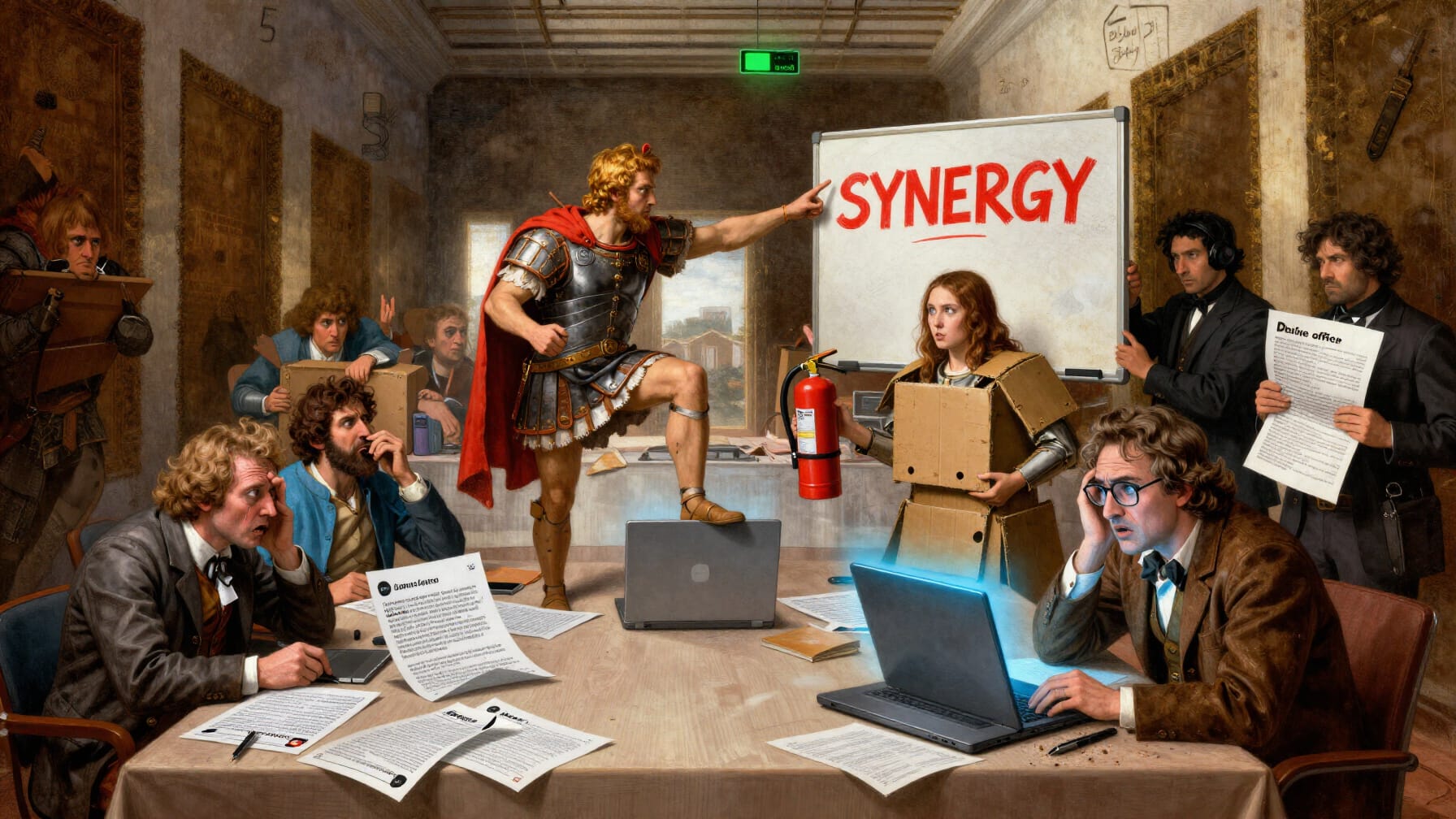
The Job: Regional bank operations manager. Responsible for quarterly reports, team "synergy," and making sure the fluorescent lights stay on.
The Situation:
Alexander walks into his first team meeting. The room smells like microwave popcorn and despair. He looks at the whiteboard, where someone has written "Q3 Goals: Increase customer satisfaction by 4%."
He stares at it. He doesn't understand. He has never understood percentages. He conquered nations through sheer will and tactical genius. How hard can a spreadsheet be?
Very hard, it turns out.
Alexander treats quarterly targets like military campaigns. He reorganizes the team into phalanxes. He demands they march on the marketing department by Tuesday. He sends increasingly aggressive emails about "capturing the synergy" and "crushing the deliverables."
HR gets involved after he suggests "decisive action" against the accounting team for missing a deadline. His performance review reads: "Alexander shows strong leadership potential but struggles with 'basic professionalism' and 'not declaring war on adjacent departments.'"
The Downfall:
He lasts six weeks. His resignation email is 47 pages long and includes a hand-drawn map of his "final campaign." The map includes a proposed invasion of the break room and a siege on the supply closet.
His boss doesn't read it. His boss never read anything over three sentences.
The Punchline: Alexander wept when there were no more worlds to conquer. He'd weep harder if he saw his quarterly bonus.
2. CICERO — Social Media Community Manager
The Resume: Rome's greatest orator. Legendary lawyer. Consul. Defender of the Republic. Wrote speeches so good people still read them two thousand years later.
The Job: Community manager for a struggling fast-food chain. Respond to customer complaints on Twitter. "Engage with the audience." "Protect the brand."
The Situation:
Cicero thinks social media is beneath him. He's right, but he needs the health insurance.
His first day, a customer tweets: "Your burger was cold and my kid cried."
Cicero drafts a response. It's 800 words. It cites Roman law, Cicero's own legal cases, and a philosophical argument about the nature of satisfaction. It ends with a call for the customer to "reflect upon your expectations, for they are the source of your disappointment."
The tweet goes viral. Not because it's good. Because it's insane.
The Downfall:
He can't stop. Every complaint gets a treatise. Every angry review gets a rebuttal. He argues with teenagers about the definition of "fresh." He challenges a food critic to a debate. He announces he will not rest until the brand's honor is restored.
The marketing director begs him to just say "we're sorry you had a bad experience."
Cicero writes a 3,000-word response about how "sincerity cannot be compressed into a platitude."
The Punchline: Cicero was killed for speaking truth to power. He was fired for speaking truth to a chicken sandwich.
3. JOAN OF ARC — Corporate Ethics Hotline Operator
The Resume: Led the French army to victory. Heard divine voices. Burned at the stake for heresy. Canonized as a saint.
The Job: Staffing the anonymous ethics hotline for a mid-sized insurance company. "See something? Say something!" (Voicemails only.)
The Situation:
Joan answers her first call. A warehouse employee reports that their supervisor has been falsifying safety inspection logs.
Joan takes this seriously. Very seriously. She has heard divine voices before. She knows a mission when she sees one.
She doesn't just file a report. She launches a crusade.
The Downfall:
Within a week, Joan has written 47 formal complaints, organized a prayer circle in the break room, and begun wearing a makeshift suit of armor made from cardboard boxes.
She confronts the supervisor in the parking lot. She demands a trial by combat. Security is called.
The ethics committee meets. They decide that while Joan's "passion" is admirable, her "approach" is "concerning." They offer her a severance package and a list of therapists who specialize in religious fervor.
The Punchline: Joan of Arc was burned at the stake for refusing to deny her visions. She was put on a PIP for the same reason.
4. HENRY FORD — UX Designer for a Meditation App
The Resume: Revolutionized manufacturing. Invented the assembly line. Made cars affordable for the masses.
The Job: User experience designer for "Calmify," a meditation app promising "inner peace in 5 minutes a day."
The Situation:
Ford believes in efficiency. The assembly line works. Why can't meditation?
He redesigns the app. Users no longer choose their own meditation. The app assigns them one. Based on an algorithm Ford refuses to explain.
The "Peace of Mind" module is 28 seconds long. The "Gratitude Journal" is a single checkbox: "Did you feel grateful today? (Yes/No)." The app shows no mercy. It does not accept "maybe."
The Downfall:
Users revolt. "I can't finish my meditation in 30 seconds," one writes.
Ford responds: "You can. You're just not trying."
He removes the customer support team. Complaints go directly to him. He replies to each one with a variation of: "Any color the customer wants, so long as it's black." No one gets the reference. The app is not about cars.
The meditation app is rated 1.2 stars. Ford is fired. He spends his last day designing a "eulogy optimization tool" that helps grieving families "streamline their mourning process."
The Punchline: Ford gave the world the assembly line. He could not give it a five-minute breathing exercise.
5. JAMES WATT — HR Benefits Coordinator
The Resume: Served as U.S. Secretary of the Interior under Reagan. Famously said there was no "materialistic need" to preserve natural resources. Also said a group of civil rights protesters looked like "a black, a woman, two Jews and a cripple." Yes, really.
The Job: HR benefits coordinator. Responsible for enrolling employees in health insurance, 401(k)s, and flexible spending accounts.
The Situation:
Watt doesn't believe in benefits. Not because he's evil. Because he genuinely doesn't understand why the company should provide them.
"Why should the company pay for your gym membership?" he asks a bewildered employee. "Have you considered simply not being unhealthy?"
The Downfall:
He denies a claim for mental health coverage, explaining that "depression is a liberal myth." He eliminates paid parental leave after calling it "an incentive against working." He describes bereavement leave as "unnecessary—the dead don't care, and the living should be working."
The class-action lawsuit is filed within three months. Watt defends himself in the deposition. The deposition is 800 pages long. It does not go well.
The Punchline: James Watt believed the end times were coming soon, so there was no need to preserve the Earth. HR agreed—about his job.
THE BONUS ENTRY (Because Five Was Arbitrary And I'm Feeling Generous)
NAPOLEON BONAPARTE — IT Support Technician
The Resume: Conquered Europe. Reformed law. Lost at Waterloo. Died in exile.
The Job: Tier 1 IT support. Resetting passwords. Telling people to turn it off and on again.
The Fallout:
Napoleon cannot handle users. He calls the help desk his "field of operations." When a user can't log in, he demands to know their "strategic intentions." When someone forgets their password, he declares a "state of emergency."
He is eventually fired for "aggressive troubleshooting." His final act is to hide a dozen keyboards in the ceiling tiles. No one finds them for years.
They become office legend. New employees are told about the "Emperor's cache." No one knows if it's real.
It is. And it still works.
The Punchline: Napoleon's greatest defeat wasn't Waterloo. It was a ticket that just said "have you tried turning it off and on again?"
THE CONCLUSION (A Modest One)
History remembers these people as geniuses. Conquerors. Visionaries.
But put them in a modern office? Give them a SaaS platform and a quarterly review? Watch them crumble.
Not because they weren't talented. Because talent is specific. Greatness in one era is a liability in another.
Alexander conquered the known world. He couldn't lead a pivot table.
Cicero defended the Roman Republic. He couldn't defend a brand from a 1-star Yelp review.
Joan heard the voice of God. She couldn't hear the voice of HR telling her to "tone it down."
And me? I'm just a guy with a website. I couldn't conquer an empire either.
But at least I know how to reset my own password.
And that's more than Napoleon could say.
Allen
FriedReads.com | Failure is relative. So is competence.
May 2026