The IRS Just 'Liked' Your Post: Welcome to the Tax Season of Clout
A thought experiment where your follower count is a W-2, your viral tweet is an audit trigger.
The IRS Just 'Liked' Your Post: Welcome to the Tax Season of Clout 📈💸
A thought experiment where your follower count is a W-2, your viral tweet is an audit trigger, and your entire personality is a deductible business expense.
It was a Tuesday. A normal, boring Tuesday. And then, every phone in the country buzzed in unison.
It wasn't an Amber Alert. It was something far more terrifying: a federal push notification.
Department of Virtual Valuation (DVV) Alert: Pursuant to Statute 7.62x39, all non-fungible social engagement ('Likes,' 'Hearts,' 'Retweets,' 'Saves') generated within U.S. digital jurisdictions is hereby classified as Attentional Income (AI). All citizens must declare their AI on Form 1-K 'The Influencer's Lament' by April 15th. Penalties for under-reporting may include garnishment of future likes, mandatory shadowbanning, or federal acquisition of your meme archive.
Silence. Then, a national scream that started digital and quickly became very, very real.
For the first time in human history, going viral was something you had to explain to an accountant.
Act I: The Birth of a Bureaucratic Monster
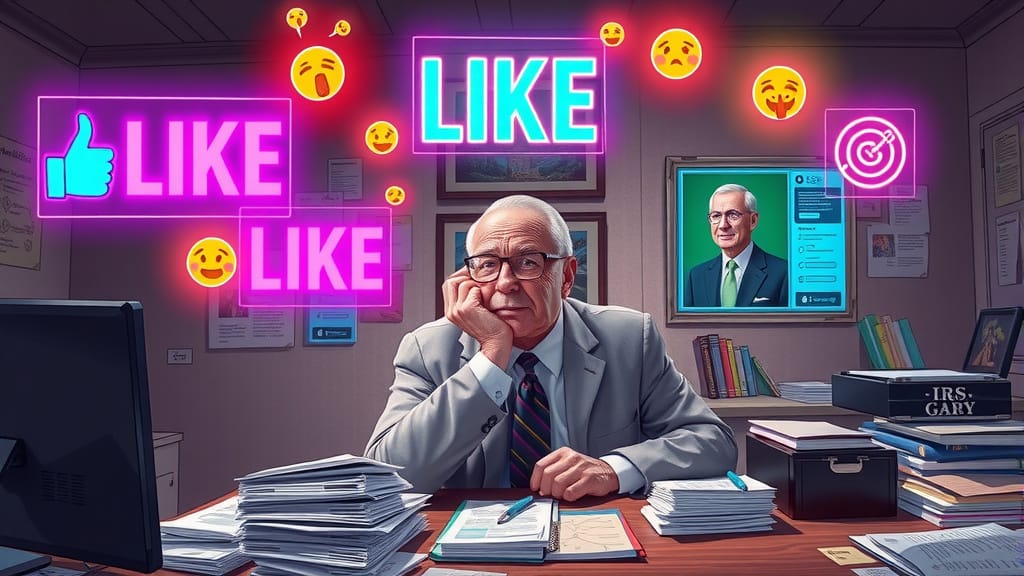
The Department of Virtual Valuation (DVV) wasn't run by Silicon Valley visionaries. It was run by Gary.
Gary was a 54-year-old career bureaucrat who owned two ties and understood blockchain only as "the thing that makes my job harder." His office smelled of stale coffee and toner. His new mandate? To determine the fair market value of a sick burn on Twitter. To audit the appreciation of an avocado toast photo. To assess the tax basis of your political take.
A new professional class was born overnight: the Clout Accountant, or "Clountant." They spoke a new language.
"Sir, we can depreciate your Finsta as a business loss," they'd say, stone-faced. "Ma'am, that controversial tweet is a high-volatility asset; we need to hedge with some apolitical cat content for stability." "The 2018 'Hot Dog or Legs' meme you resurrected? That's intellectual property amortization. We'll need forms 8949 and Sched-DANK."
Act II: The Panic Sets In (Case Studies in Chaos)
Case Study 1: The Artisanal Sourdough Micro-Influencer
- Follower Count: 1,500
- AI Stream: ~200 likes per photo of rustic, flour-dusted loaves.
- The Snark: She wasn't rich. She was engagement-poor. Her entire "brand" netted $83.47 in Attentional Income but required $200 a month in heirloom grains, linen backdrops, and bespoke butter knives. The DVV saw a business. Her bank account saw a crippling hobby. She became the first person in history to file for Chapter 7 Clout Bankruptcy. Her assets? One used ring light, a trademarked hashtag (#BreadIsMyLoveLanguage), and 14 unpaid collaborations with small-batch hot sauce companies.
Case Study 2: The Political Pundit's Deduction Dilemma
- Follower Count: 2.4 Million
- AI Stream: A torrent of rage-likes, hate-shares, and furious quote-tweets.
- The Snark: His Clountant had questions. "Is inciting partisan fury a legitimate business expense? Can we deduct the cost of your 'angry red face' makeup? Is the hate-follow from the opposition considered charitable giving, as it provides them a unifying enemy?" They settled on classifying his outrage as R&D: Research & Demagoguery. The new Form 1-K had a checkbox that made him seethe: ☐ Check here if your primary product is moral panic.
Case Study 3: Grandpa Joe and the Taxable Dog Pic
- Follower Count: 47 (all family)
- AI Stream: One (1) photo of his sleeping granddog, "Mr. Wiggles."
- The Snark: Joe, who still prints out his emails, received a DVV notice for unreported "Intra-Familial Micro-Virality." His tax bill: $7.32. He tried to pay with a physical check, memo line: "FOR THE DOG PIC." The system rejected it. He spent 3 hours on hold with the DVV helpline, only to be told he could settle his debt by "liking" 500 government posts about fiscal responsibility.
Case Study 4: The Shadowy Underworld of "Like-Laundering"
- The Problem: A black market emerges. "You like my 10 posts, I'll like yours." Bot farms pivot from influence to taxable income fabrication.
- The Snark: Gary the DVV Agent became an unlikely cyber-sleuth, tracing digital trails of fake enthusiasm. He broke up an "Engagement Ring"—a network of shell accounts that existed only to circularly like each other's content about minimalist desk setups. The perps were charged with "Conspiracy to Commit Artificial Engagement." Their defense? "Your honor, those likes were real to us!"
Act III: The Societal Earthquake (Or, Why Your Life is Now a Ledger)
- The Death of the Sincere 'Like': Liking your friend's baby picture is no longer an endorsement of cuteness. It's a financial endorsement with potential gift-tax implications. Social media becomes a cold, silent, transactional spreadsheet. The most common comment? "This post has been evaluated for potential AI. A reaction is pending accounting review."
- The New American Caste System:
- The Engagement Elite: Paying their million-dollar tax bills in verified blue checks and sponsored post credits.
- The Middle-Class Scrollers: Living in fear of an audit over a meme that did "suspiciously well" in 2023. Hiding their phones during tax season.
- The Attention-Poor: A new counter-culture hero. They post only blurry photos of their feet and deliberately boring updates about laundry. Their most prized asset? A rock-bottom engagement rate. They are the new tax fugitives, and they are at peace.
- The Ultimate, Darkly Comic Irony: In its quest to tax our vanity, the government accidentally built the most accurate map of human desire, insecurity, and joy ever assembled. The DVV doesn't just know you looked at cat videos at 2 AM. They know exactly how much that joy was worth to you, priced to the millicent. Your secrets aren't sold to advertisers; they're filed in triplicate under "Subconscious Revenue Streams."
Epilogue: April 14th, 2027
The nation is in chaos. A collective, sleep-deprived panic grips the land.
People are frantically deleting old tweets (deletions classified as "digital asset disposal," may trigger capital gains). Couples are arguing over joint vs. separate filing for their couple's Instagram account. Teenagers are claiming their vibe-curation as a dependent.
And the most-liked post of the year? A DVV tutorial video titled "Filing Your 1-K: A Step-by-Step Guide." It garnered 50 million likes. Every single one, taxable.
We dreamed of monetizing our attention. We just never dreamed the partner cutting the check would be the Internal Revenue Service. The "Attention Economy" finally got the ultimate, bureaucratic attention it deserved.
So the next time you go to double-tap, ask yourself the modern American question: Is this fleeting moment of validation worth 0.003 cents of reported income?
The algorithm always wins. But now, it sends you a 1099.
Just filing my digital existence as a hobby,
Allen
FriedReads.com | @Allen_Fried