The Red Pahanat Declares: "Tipflation" Is Now a Crime Against Humanity
A Satirical Declaration About Guilt Screens, Emotional Manipulation, and the Death of the Tip Jar
September 2026
I'm sitting on my couch.
My Supreme Leader couch. The one where I run the One World Council and eat chips. The one where I make world-changing declarations while wearing sweatpants.
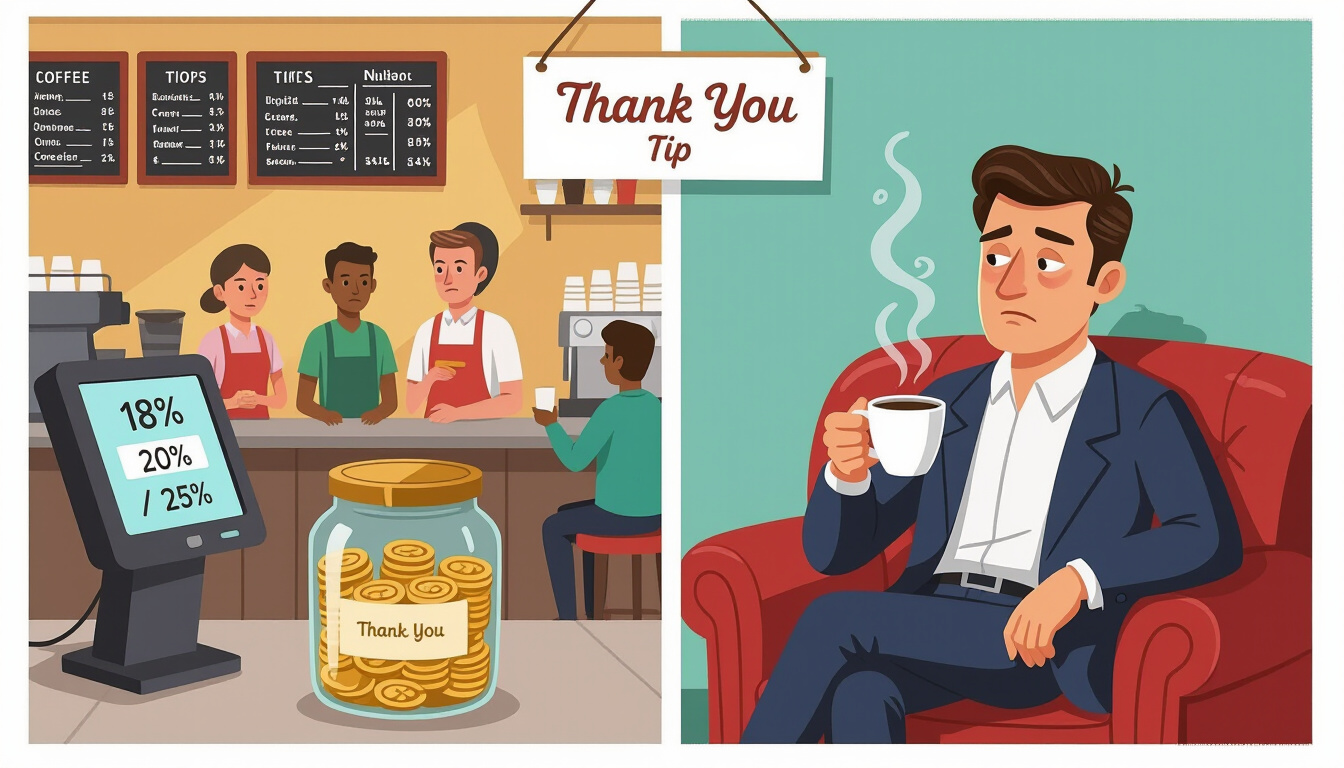
I just bought a coffee. A simple coffee. A $4 coffee. The barista handed me a cup. I handed them my card. They flipped the screen around.
Tip options: 18%, 20%, 25%.
For handing me a coffee.
I stared at the screen. The barista stared at me. The line behind me stared at me. The whole world stared at me.
I felt something I haven't felt since the last time I was asked to tip at a self-checkout kiosk. Something primal. Something ancient. Something that made me want to flip the screen back and scream.
Rage. But also... shame. The shame of not tipping. The shame of being judged. The shame of being seen as cheap.
For a coffee. That I poured myself. At a machine. That I operated.
This isn't a tip. This is a hostage negotiation. And I'm the hostage.
So I, the Red Pahanat, Supreme Leader of the One World Council, sole occupant of my living room, and the only world leader without a term limit, am declaring it.
Tipflation is now a crime against humanity.
Not because I'm cheap. Because I'm tired. Because you're tired. Because everyone is tired of being guilted into paying extra for things that used to be free.
Let me explain.
THE RESEARCH: This Is Actually Happening
You think I'm exaggerating? I'm not. It's everywhere.
77% of Americans Think Tipping Has Gotten Out of Control
A survey of 1,005 U.S. adults found that 77% believe tipping culture in the United States has gotten out of control. That's not a majority. That's a supermajority. That's almost everyone.
65% of Consumers Say They're Fed Up with Tipping
A Popmenu survey found that 65% of consumers say they're fed up with tipping, up from 60% last year and 53% in 2023. The numbers are going up. The patience is going down.
Consumers Spend $150 a Year on Tips They Consider Unnecessary
According to a MarketWatch report, consumers said they spent $150 on tips they felt were unnecessary in the past year. That's $150 for tips that didn't feel earned. $150 for tips that felt forced. $150 for tips that were demanded by a screen, not earned by service.
44% Are Leaving Smaller Tips Than Last Year
A Money survey found that 44% of respondents are leaving smaller tips this year compared to last. This includes 35% who are tipping less at restaurants, 24% who have pared their grocery delivery tips, and 19% who have cut back on tipping for taxis or rideshares.
The "Tip Creep" Has Gone Too Far
Tipping used to be for sit-down restaurants. Then it was for coffee shops. Then it was for fast food. Then it was for self-checkout. Now it's for everything. Bookstores. Dry cleaners. Auto shops. Farmers markets. Every transaction ends with a screen asking for more money.
One etiquette expert called the suggested amounts "bonkers." A $1, $2, or $3 tip suggestion on a $3 cup of coffee is a 33%, 66%, or 100% tip.
That's not a tip. That's a ransom.
The Tip Screen Is Designed to Manipulate
The tip screen isn't an accident. It's a technology. It's a system. It's a tool. And it's designed to make you pay more.
A study found that Americans tip 15% more on average when they only have to tap a button on a screen rather than pulling cash out of their wallet. And 64% of people tip over 10% more if tipping digitally.
The screen isn't there for convenience. It's there to extract money.
THE PROBLEM: You're Being Guilted Into Paying More
Here's the thing about the tip screen.
It's not just a question. It's a test. A moral test. A test you didn't ask to take.
The Social Anxiety
"When they used to bring the bill to your table, you signed and left. Now with the machine, they're standing and watching. There's a social anxiety," said Wayne Smith, a professor of hospitality and tourism management.
That's the point. That's the design. The screen is flipped around. The barista is standing there. The line is behind you. You can't think. You can't calculate. You can't decide.
You just tap. You just tip. You just give them more money because it's easier than saying no.
The Guilt
70% of Canadians have left a store or café feeling guilty because they didn't tip enough or at all. That's a lot of emotional weight over a sandwich or latte.
You didn't do anything wrong. You just bought something. You just paid the advertised price. You just engaged in a transaction.
But the screen made you feel bad. The screen made you feel cheap. The screen made you feel like a bad person.
For not giving extra money to a corporation.
The Injustice
The suggested tips are calculated on the post-tax total in most places. So you're tipping on the tax. You're paying extra for the privilege of being taxed.
Quebec made it illegal for payment terminals to calculate tips on post-tax amounts. The rest of the world hasn't caught up.
The Worker Is Caught in the Middle
Here's the thing: the barista didn't set the tip screen. The barista didn't choose the percentages. The barista is just as trapped as you are.
They're standing there, watching you decide. They know it's awkward. They know it's uncomfortable. They know the screen is manipulative.
But they also need the money. They also rely on tips. They also can't afford to say no.
The system is broken. And the worker is caught in the middle.
THE RED PAHANAT'S SOLUTION
Effective immediately, I, the Red Pahanat, do hereby declare the following decrees:
Decree #1: The "Tip Screen Abolition Act"
All digital tip screens are hereby abolished. No more guilt screens. No more emotional manipulation. No more percentages displayed before you've even tasted the coffee.
The tip jar is restored. The tip jar is the only acceptable method of soliciting tips. The tip jar is voluntary. The tip jar is silent. The tip jar doesn't judge.
The Red Pahanat has spoken. The Red Pahanat misses the tip jar. The Red Pahanat will bring it back.
Decree #2: The "Pre-Tax Calculation Act"
All tips must be calculated on the pre-tax total. If you buy a $10 sandwich and the tax is $1.50, the tip is calculated on $10, not $11.50.
The Red Pahanat will not pay a tip on a tax. The Red Pahanat will not pay extra for the privilege of being taxed. The Red Pahanat is wise to this trick. The Red Pahanat is always wise.
Decree #3: The "Fair Wage Act"
All workers must be paid a living wage. Tipping must be supplemental, not foundational. Employers cannot use tips to subsidize wages.
If your business model requires guilt to survive, your business model is broken. The Red Pahanat will not fix it for you. The Red Pahanat will eat chips while you figure it out.
Decree #4: The "No Tipping Before Service Act"
No tip can be requested before the service is delivered. You cannot ask for a tip before handing over the coffee. You cannot ask for a tip before the food arrives. You cannot ask for a tip for something you haven't done yet.
The Red Pahanat is not tipping in advance. The Red Pahanat is not a venture capitalist. The Red Pahanat is a customer.
Decree #5: The "Transparency Act"
All tipping policies must be clearly displayed. Who gets the tip? How is it split? Does management take a cut? The Red Pahanat demands answers.
Tipflation is now a crime against humanity. And I have a couch, a chip bag, and a scoreboard.
THE Q&A — Imaginary Questions From Imaginary Citizens
Citizen: "Red Pahanat, what about the workers who rely on tips?"
Red Pahanat: "They should be paid a living wage. Tips should be extra, not essential. The Red Pahanat is not against workers. The Red Pahanat is against systems that force customers to subsidize wages while corporations keep the profits."
Citizen: "What about small businesses?"
Red Pahanat: "Small businesses can have tip jars. Tip jars are fine. Tip jars are voluntary. Tip jars don't flip around and stare at you while you decide. The Red Pahanat supports the tip jar. The Red Pahanat has fond memories of tip jars."
Citizen: "What if I want to tip?"
Red Pahanat: "Then tip. That's fine. The Red Pahanat encourages generosity. The Red Pahanat does not encourage guilt. There's a difference."
Citizen: "This is insane."
Red Pahanat: "Is it more insane than a $3 tip suggestion on a $3 coffee? Is it more insane than being asked to tip at a self-checkout? Is it more insane than feeling guilty for buying a muffin? The Red Pahanat thinks not."
THE SATIRICAL PUNCHLINE
Tipflation isn't just annoying. It's a crime. A slow, creeping, screen-flipping crime.
They want you to feel guilty. They want you to feel cheap. They want you to tap the 25% button because you're too embarrassed to tap "No Tip."
They want you to pay more. They want you to feel bad. They want you to subsidize their wages while they keep the profits.
And they've convinced you that this is normal. That this is the way things work now. That you're a bad person if you don't tip 25% for a coffee you poured yourself.
It's not. It's a choice. And you can choose differently.
The Red Pahanat's Warning:
"At this rate, your children will be asked to tip at their own birthday parties. Your grandchildren will be prompted to tip at the doctor's office. Your great-grandchildren will have to tip to breathe."
"Stop the guilt. Demand fair wages. Bring back the tip jar."
"The screen is flipped. The barista is watching. And you're paying a 25% tip for a coffee you don't even want."
THE FINAL LINE
You used to tip for good service. Now you tip because a screen told you to.
You used to reward excellence. Now you pay to avoid awkwardness.
You used to have a choice. Now you have a percentage.
The Red Pahanat has spoken. Tipflation is a crime. Tip what you want. Tip when you want. Or don't tip at all.
The tip jar is empty. The screen is off. And the Red Pahanat is eating chips.
👑📜🖥️
The Red Pahanat Supreme Leader of the One World Council (and My Living Room) FriedReads.com | Order, not freedom. Fair wages, not guilt. Snacks, not service fees. September 2026